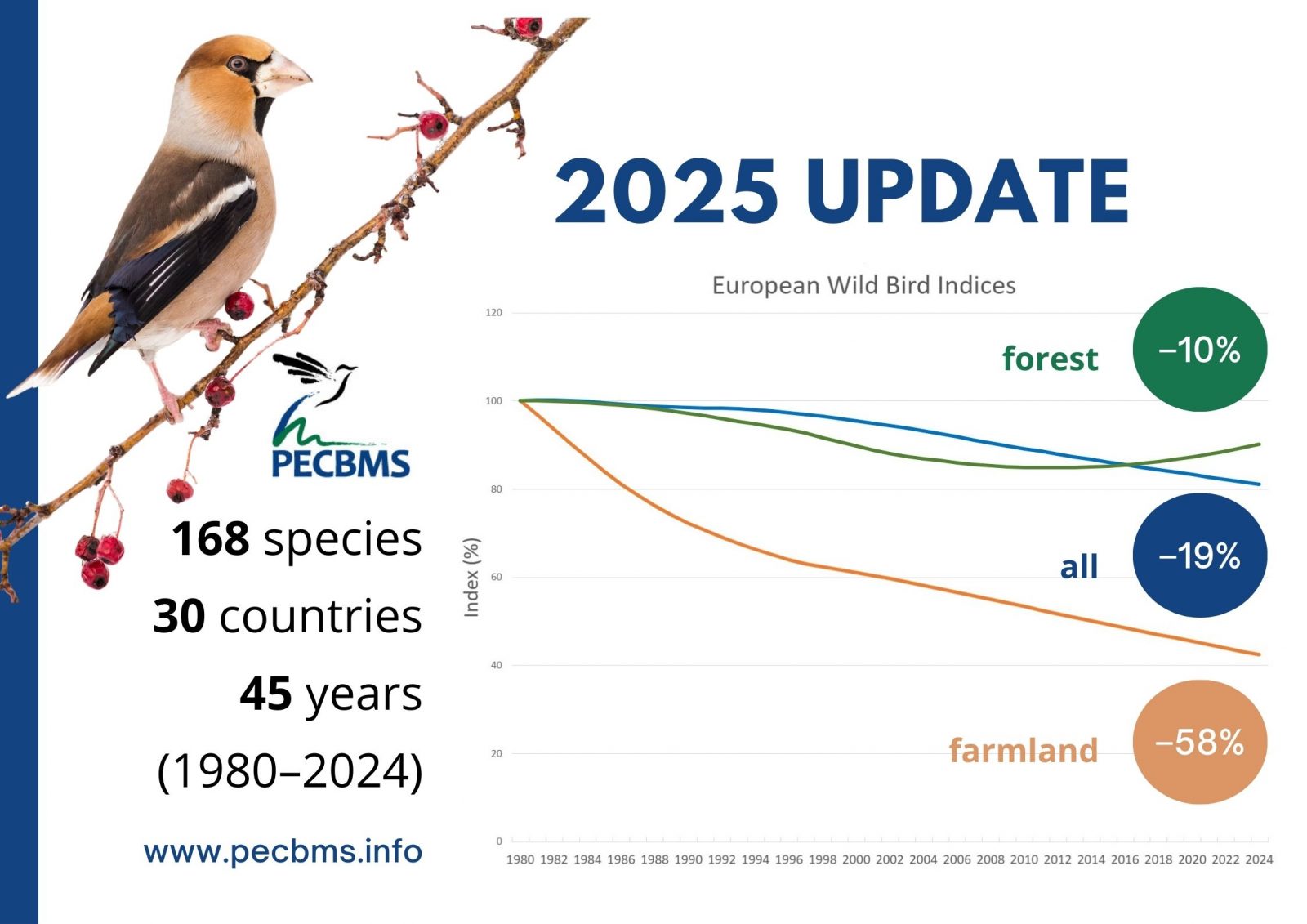
The 2024 Wild Bird Indices update shows overall decline in common birds breeding in Europe, while most pronounced is the decline in the farmland species.
European Wild Bird Indices, 2025 update
December 15, 2025
The Pan-European Common Bird Monitoring Scheme (PECBMS) presents the 2025 update of the European Wild Bird Indices (multi-species indicators), covering the period 1980–2024. The results are based on data for 168 wild bird species collected from 30 European countries.
The 2024 Wild Bird Indices update shows overall decline in common birds breeding in Europe, while most pronounced is the decline in the farmland species.
Download the latest European and EU indicators up to 2024 (Data Provision and Co-authorship Policies apply).
Acknowledgements
The production of European and EU indices, trends, and indicators would not be possible without the tremendous effort of the coordinators of national breeding bird surveys and the many volunteer observers who collect the field data. PECBMS also receives regular support from numerous individuals and organisations through their advice and assistance.
A complete list of contributors and partner organisations is provided in the Acknowledgements.
Scope of Indicators
This update includes indicators for farmland, forest, and all birds at the European level and four European regions: Western, Northern, Central & Eastern, and Southern Europe. Indicators are also presented for the EU as a whole, and separately for New and Old EU Member States.
At the European level, all 30 PECBMS countries are included in the indicators: Andorra, Austria, Belgium, Bulgaria, Croatia, Cyprus, Czechia, Denmark, Estonia, Finland, France, Germany, Greece, Hungary, Italy, Latvia, Lithuania, Luxembourg, the Netherlands, Norway, Poland, Portugal, the Republic of Ireland, Romania, Slovakia, Slovenia, Spain, Sweden, Switzerland, and the United Kingdom.
The EU-level indicators include the data from 26 EU Member states: Austria, Belgium, Bulgaria, Croatia, Cyprus, Czechia, Denmark, Estonia, Finland, France, Germany, Greece, Hungary, Italy, Latvia, Lithuania, Luxembourg, the Netherlands, Poland, Portugal, the Republic of Ireland, Romania, Slovakia, Slovenia, Spain, and Sweden.
The only remaining Member State not yet included is Malta. As a national bird survey is already underway in the country, Malta is expected to contribute its national data to the PECBMS in the near future.
Data
The source data for calculating the indicators are supranational species indices – regional, and, at a higher level, European or EU. These supranational species indices are derived from national species indices. The procedure is summarised in Trends of wild birds in Europe and described in detail in Methods, Chapter 1: National species indices and trends, and Chapter 2: Supranational species indices and trends.
Although PECBMS maintains European and EU indices for 170 species, two endemic species – Cyprus wheatear (Oenanthe cypriaca) and Cyprus warbler (Curruca melanothorax) – are excluded from the indicators, as they occur only in Cyprus. Therefore, the main indicators for the full PECBMS species dataset (All Bird Index) include 168 species, regardless of their habitat classification. The number of species used in the Farmland Bird Index (39 species) and the Forest Bird Index (34 species) is not affected by the two endemics. The number of species used for the indicator calculation remains unchanged from the previous year.
To assign all PECBMS species to these main Habitat types – farmland, forest, and other – we use the PECBMS single European species habitat classification adopted at the 2005 PECBMS workshop in Prague. Detailed information, including the species list and their habitat classifications, is available in the Methods section, Chapter 3, Box: Species Selection and Classification.
Methods
The PECBMS compute the indicators using the MSI-tool (R-script) for calculating Multi-Species Indicators (MSI) and trends following Soldaat et al. (2017). European, EU, and regional species indices, including their standard errors, serve as source data for the respective indicators. The calculation of multi-species indicators is based on a Monte Carlo simulation of annual species indices and their standard errors. The method also incorporates chaining, which enables handling of uneven time series (since the index for some species included in the indicator began later than others).
The tool produces both unsmoothed and smoothed indicator values with confidence intervals. These smoothed indicators are presented as the official PECBMS outputs.
Further details on the production of the indicators are provided in Methods, Chapter 3: Multispecies indicators.
Results
We present European, EU, and regional smoothed indicators for the 2025 through interactive tables. The tables summarise the time span of the indicators, the number of species included, and the indicator Trend, which describes the percentage change between the first and last year of the indicator.
Graphs of the indicators are available by clicking on the species names in the table and confirming the selection with the Show button. The graphs display the smoothed indicators, including their lower and upper confidence intervals, as well as the unsmoothed indicator values for the period from 1980 onward.
The list of species, their trends, and the list of countries are shown alongside each indicator graph. The graph also shows the number of species included in each indicator that are declining (moderately or steeply), increasing (moderately or strongly), stable, or uncertain.
Download and reference
The main indicators for Europe and the EU are freely available for download as an Excel file (Data provision and co-authorship policies apply).
We kindly ask that you acknowledge the data source as EBCC/BirdLife/RSPB/CSO whenever you use the data.
Recommended citation for the PECBMS 2025 update:
PECBMS 2025. The State of Europe´s Wild Birds 2025. CSO, Prague, Czech Republic. (download as PDF)
The data is licensed under a Creative Commons license CC BY-NC 4.0 and is governed by applicable copyright law (Creative Commons Legal Code). Creative Commons. January 9, 2008. Retrieved February 22, 2010.
Note: We recommend interpreting year-to-year changes in index values with caution. Readers should pay attention to the species legend. We strongly advise consulting the PECBMS coordinator, Eva Šilarová (silarova@birdlife.cz), before using the results presented in this report.