Report on the Pan-European Common Bird Monitoring Scheme, June 2026
July 25, 2026
This report summarises the activities of the Pan-European Common Bird Monitoring Scheme (PECBMS) undertaken between 20 August 2025 and 29 June 2026 under the European Commission-funded project"Service Contract for providing technical and scientific support in relation to the delivery and development of wild bird indicators for the EU (2023–2026)."
Summary
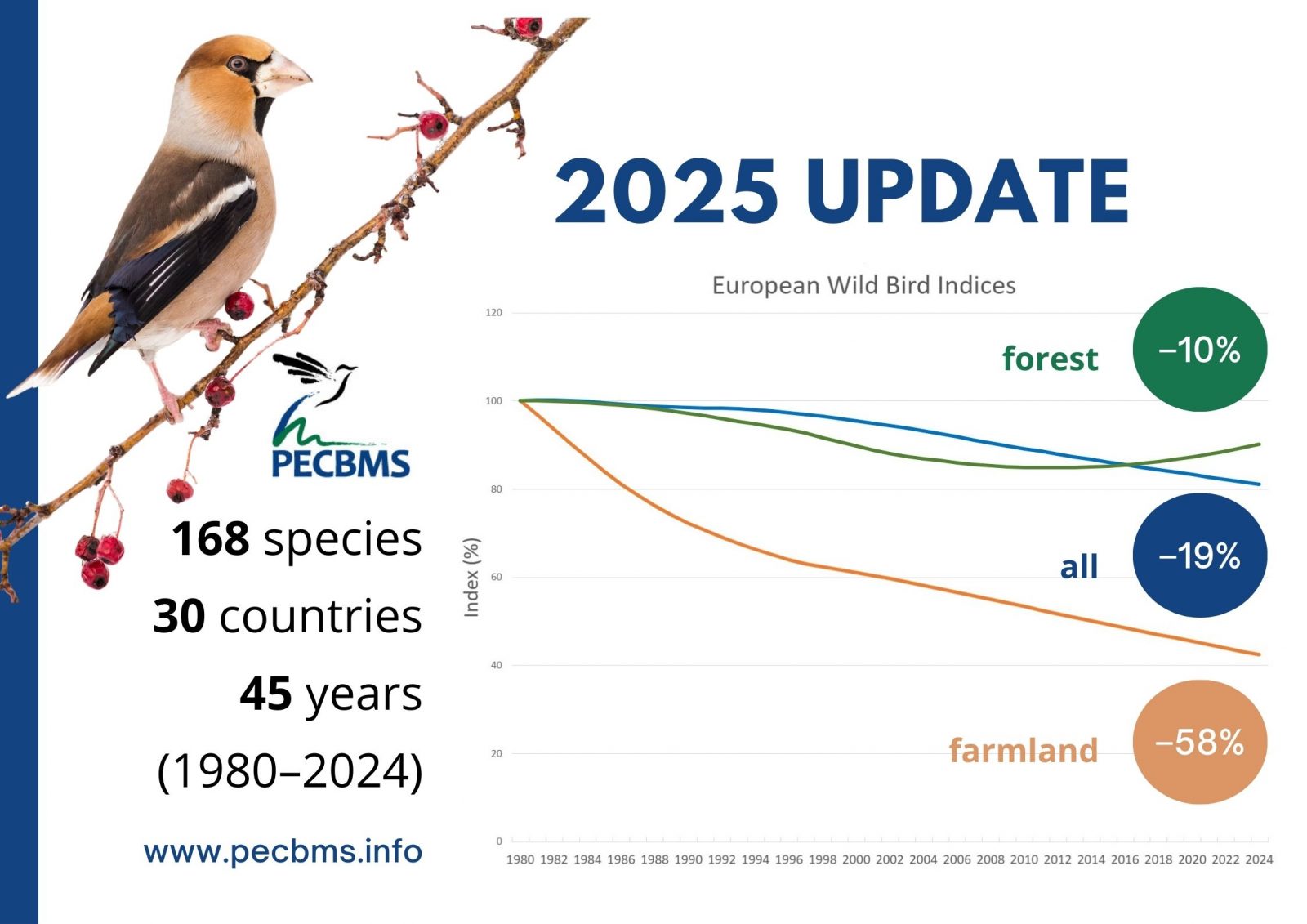
During the reporting period, we delivered the 2025 annual update of European bird trends and indicators, covering 170 common bird species from across Europe. The updated European species trends and indices, together with the All Bird Index, Farmland Bird Index and Forest Bird Index, were published on 15 December 2025. All participating countries have already submitted their 2025 monitoring data, and extensive data checks are currently underway ahead of the next European update planned for December 2026.
We continued the development of the new Urban Bird Index, which aims to measure biodiversity trends and the effectiveness of urban greening across Europe. Spatial analyses and modelling have been completed using updated site-level monitoring data, and preliminary results were presented to the PECBMS network.
Work also progressed on the development of flyway-specific trends for long-distance migratory birds. Six declining migratory species have been selected, and collaboration with national monitoring coordinators is ongoing to prepare flyway-level population trends.
In communication and dissemination activities, we informed European Commission services about the latest indicator updates, supported discussions on publishing outputs through existing European Commission platforms, and continued making all PECBMS outputs freely available through the PECBMS website and public repositories.
The PECBMS team also contributed to scientific research and policy discussions, including preparations for a dedicated stakeholder workshop addressing the role of bird indicators in evaluating EU biodiversity, agricultural and restoration policies.
Project funding
The project is funded mainly by the European Commission through the contract:
“Service Contract for providing technical and scientific support in relation to the delivery and development of wild bird indicators for the EU (2023–2026)”.
The work is delivered by a consortium consisting of:
- Czech Society for Ornithology (CSO, Czechia)
- Royal Society for the Protection of Birds (RSPB, United Kingdom)
- Catalan Institute of Ornithology (ICO, Spain)
- CREAF, Spain
- IREC-CSIC, Spain
Production of European species trends and indicators
On 15 December 2025, PECBMS published updated European population trends and indices for 170 common bird species, based on monitoring data provided through the PECBMS network. The update included data up to 2024, while data collected during the 2025 breeding season are currently undergoing validation and quality checks for publication in 2026.
The calculation of supranational indices followed the standard PECBMS methodology, combining national monitoring outputs while accounting for the proportion of each species’ European population in participating countries. Extensive quality-control procedures were carried out at national and European levels to ensure data consistency and reliability.
To improve accessibility and citation of PECBMS results, we also produced a dedicated State of Europe’s Wild Birds 2025 PDF publication, bringing together methodological information, key outputs, links to indicators and species trends, and information on participating monitoring schemes.
European Wild Bird Indices
The following European indicators were updated and published as part of the annual release:
- All Bird Index
- Farmland Bird Index
- Forest Bird Index
The indicators are based on a set of 168 native European bird species classified according to their primary habitat associations. Species selection and classification follow long-established PECBMS procedures developed in cooperation with national experts across Europe.
Data currently originate from 30 countries, including 26 EU Member States. Malta remains the only EU Member State not yet included in the indicator calculations, although collaboration with BirdLife Malta continues and inclusion is expected in future updates.
Development of a European Urban Bird Index
A major focus of the current contract is the development of a new Urban Bird Index (UBI). The indicator is designed to provide information on biodiversity trends, environmental quality and the effects of greening measures in urban environments.
During the reporting period, the project team:
- updated site-level monitoring data across Europe,
- classified monitoring plots as urban or rural,
- analysed urban green-space coverage,
- modelled bird population responses to urban greening,
- developed preliminary regional and European indicators,
- tested indicator sensitivity to changes in urban greening,
- presented results to the PECBMS network and expert groups,
- refined the methodology following consultations.
The Urban Bird Index remains under development and is expected to be completed by the end of the year 2026.
Flyway trends of long-distance migratory species
Together with experts from IREC-CSIC, we continued work on flyway-specific population trends for long-distance migratory birds. Six species were selected for analysis:
- Tree Pipit (Anthus trivialis)
- Common Cuckoo (Cuculus canorus)
- Ortolan Bunting (Emberiza hortulana)
- Spotted Flycatcher (Muscicapa striata)
- Northern Wheatear (Oenanthe oenanthe)
- Willow Warbler (Phylloscopus trochilus)
Permissions to use national data have been sought from participating countries, and work is underway to separate population data where national territories contain more than one migratory flyway. The resulting flyway-specific trends will be produced using the most recent data available through 2025.
Dissemination and policy support
The PECBMS team informed DG Environment about all indicator and species-trend updates immediately following publication. We also continued discussions on how best to make contract outputs available through European Commission platforms and websites.
European bird indicators continue to be used by major European institutions, including:
- Eurostat, which incorporated the bird index into the 2026 EU Sustainable Development Goals Monitoring Report;
- the European Environment Agency (EEA), which publishes annual assessments based on PECBMS indicators.
In addition, PECBMS datasets and outputs remain freely accessible through the PECBMS website and publicly archived datasets. Updated data were also released through the Zenodo repository in early 2026 following approval from national coordinators.
Research and scientific publications
Work continued on a new scientific paper describing and validating the PECBMS methodology, including the use of citizen science data for biodiversity indicators. The manuscript is planned for submission by the end of 2026.
Recent publications using PECBMS data:
Carles Carboneras, Eva Šilarová, Jana Škorpilová, Beatriz Arroyo (2026). Applying PECBMS data in conservation: the Turtle Dove population decline, adaptive management, and recovery. Environmental and Experimental Biology Vol. 24 No. 1; 57–61. https://journal.lu.lv/eeb/article/view/3088
Sergi Herrando, Guillem Pocull, Sara Fraixedas, Anna Gamero, David Martí, Oriol Solà, Dani Villero, Verena Keller, Petr Voříšek, Alena Klvaňová, Gabriel Gargallo, Vitalie Ajder, Marc Anton, Ainars Aunins, Dawn Balmer, Mattia Brambilla, Tomasz Chodkiewicz, Przemysław Chylarecki, Cristi Domșa, Vlatka Dumbović Mazal, Virginia Escandell, Néstor Fernández, Ruud Foppen, Juan Gallego-Zamorano, Carlos Godinho, Irene Guerrero, Christina Ieronymidou, Frédéric Jiguet, Aleksi Lehikoinen, Primož Kmecl, Peter Knaus, Lechosław Kuczyński, Åke Lindström, Qenan Maxhuni, Blas Molina, Jean-Yves Paquet, Maria Luisa Paracchini, Danae Portolou, Draženko Z. Rajković, Dimitrije Radišić, Jiří Reif, Paul Shimmings, Henk Sierdsema, Jovica Sjeničić, Karel Šťastný, Bård G. Stokke, Nicolas Strebel, Zoltán D. Szabó, Tibor Szép, Norbert Teufelbauer, Nicolas Titeux, Sven Trautmann, Judit Veres-Szászkac, Thomas Vikstrøm, Lluís Brotons (2026). Providing regular and frequent maps of losses and gains of farmland birds based on European monitoring data. Conservation Biology, e70268. https://doi.org/10.1111/cobi.70268
Daniel Kissling, Maria Lumbierres, Anne Lyche Solheim, Camino Liquete, Tom D. Breeze, Aletta Bonn, Ian McCallum, Joachim Maes, Tim Hirsch, Roy H. A. van Grunsven, Pedro Beja, Bruno Smets, César Capinha, Ana Ceia-Hasse, Néstor Fernández, Joana Santana, Francisco Moreira, Jessica Junker, Florian Leese, Eleanor Hammond, Lluís Brotons, Alejandra Morán-Ordóñez, Dimitrios Bormpoudakis, Helge Bruelheide, Marcel Buchhorn, Irene Calderon-Sanou, Miguel Fernandez, Anna Gamero, Anne Gobin, Irene Guerrero, Peter Haase, Ute Jandt, Alena Klvaňová, Ingolf Kühn, Martina Marei Viti, Kristian Meissner, Marija Milanović, S. Jannicke Moe, Simon G. Potts, Astrid Schmidt-Kloiber, Jose Valdez, Dani Villero & Henrique Miguel (2026): Building the backbone for Europe’s biodiversity monitoring. Nature Reviews Biodiversity. DOI: 10.1038/s44358-026-00140-6
Supporting biodiversity policy
Throughout the year, PECBMS continued collaboration with DG Environment, DG Agriculture, Eurostat, the Joint Research Centre and the European Environment Agency. A dedicated stakeholder workshop is planned for October 2026 to discuss monitoring methods, data availability and the use of bird indicators in evaluating EU policies, including:
- the Common Agricultural Policy (CAP),
- National Strategic Plans,
- the Nature Restoration Regulation,
- broader EU biodiversity objectives.
The workshop will also explore how wild bird indicators can support assessments of Member State progress in delivering European environmental policy commitments.