
The strongest agreement between the two schemes was found in common and easily detectable species, especially farmland birds and long-distance migrants. Photo by Michal Dobeš
Modernizing bird monitoring while preserving long-term trends
May 26, 2026
A new study from Czechia explores a challenge faced by many long-term biodiversity monitoring programmes: how to replace an established bird monitoring scheme with a more modern one without losing the value of decades of data. The research compared two nationwide common bird monitoring schemes that operated in parallel between 2018 and 2024. The original scheme, running since 1982, relied on point counts at sites chosen freely by volunteer fieldworkers. The new scheme, launched in 2018, introduced a more statistically robust design based on randomly selected transects and digital field recording.
The strongest agreement between the two schemes was found in common and easily detectable species, especially farmland birds and long-distance migrants. Photo by Michal Dobeš
The authors of the paper (Jechumtál Skálová, A., Voříšek, P., Vermouzek, Morelli F. Reif J. 2026. Replacing a long-running common bird monitoring scheme by a new one: what predicts the correspondence of population changes between the schemes? J. Ornithol. https://doi.org/10.1007/s10336-026-02365-w) analysed population indices and trends for 104 common bird species and asked how closely the two schemes produced comparable results. Overall, the correspondence between the schemes was moderate, but varied strongly among species. The strongest agreement was found in common and easily detectable species, especially farmland birds and long-distance migrants. In contrast, rare species, wetland birds, and species with lower detectability showed weaker correspondence between the schemes.
The study highlights the importance of sample size and detectability in biodiversity monitoring. Common species are recorded at many sites, making their population trends less sensitive to sampling biases. Similarly, species that are easier to hear or observe are more consistently detected across different survey methods. The authors also suggest that long-distance migrants may show better correlation because their breeding arrival is more synchronized, making them easier to monitor consistently.
An important practical result concerns the overlap period between old and new schemes. The correlation between schemes improved as more years of parallel monitoring accumulated, but the improvement became small after about five years. According to the authors, a five-year overlap may therefore be sufficient when transitioning between monitoring schemes, reducing costs and organizational demands.
The study also demonstrates that introducing randomization into site selection improved habitat representativeness compared to the older free choice (volunteer-selected) design. This is particularly relevant for large-cale biodiversity indicators and conservation assessments that depend on unbiased long-term datasets.
Overall, the paper provides one of the first quantitative evaluations of how species traits influence correspondence between monitoring schemes. Its findings offer practical guidance for countries planning to modernize long-term bird monitoring while preserving continuity of population trends that are crucial for conservation research and policy.
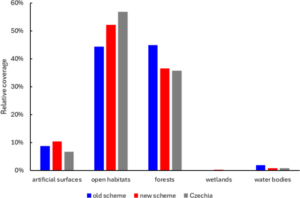
Comparison of habitat representation between the old and new schemes
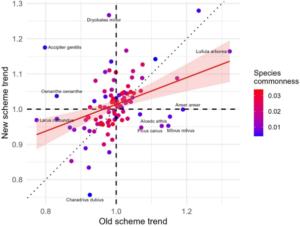
Comparison of population trends between schemes across species
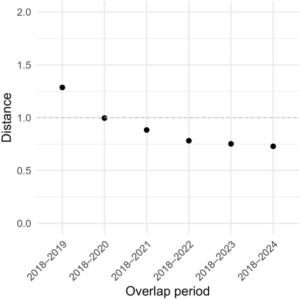
Effect of overlap length on agreement between schemes
This article is licensed under a Creative Commons Attribution 4.0 International License, which permits use, sharing, adaptation, distribution and reproduction in any medium or format, as long as you give appropriate credit to the original author(s) and the source, provide a link to the Creative Commons licence, and indicate if changes were made. The images or other third party material in this article are included in the article’s Creative Commons licence, unless indicated otherwise in a credit line to the material. If material is not included in the article’s Creative Commons licence and your intended use is not permitted by statutory regulation or exceeds the permitted use, you will need to obtain permission directly from the copyright holder.
Petr Voříšek
This is an open access article distributed under the terms of the Creative Commons CC BY license, which permits unrestricted use, distribution, and reproduction in any medium, provided the original work is properly cited.