Update on the overview of Generic Breeding Bird Monitoring Schemes in Europe
September 14, 2026
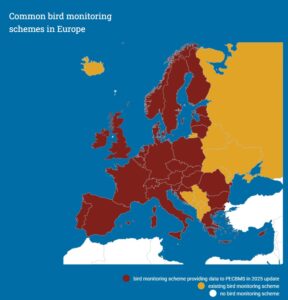
This spring, we circulated the regular questionnaire to update information on the ongoing programmes. Thanks to the answers from the national coordinators in 44 countries, the website overview is now up to date. European breeding bird monitoring continues to expand, increasing the number of volunteers and the number of species for which reliable outputs are produced.
The generic breeding bird monitoring runs in 44 countries within 49 different schemes. Since 2023, four new schemes have started:
- 2023: Montenegro
- 2024: Bosnia and Herzegovina; Albania
- 2025: Kosovo
Each year, approximately 15 200 volunteers count birds in the field following standardised methods. In 13 countries, the number has risen since the last update. The biggest gain in volunteers was in Germany (200 new volunteers). Bulgaria (+180) and Slovakia (+ 42) doubled, and Lithuania (+ 26) and Slovenia (+ 31) almost doubled their numbers of volunteers. Only four countries lost volunteers, mainly in Spain (- 30 % of volunteers). Altogether, 446 new volunteers have been recruited across Europe for bird monitoring.
In 13 countries, data quality has improved, allowing national coordinators to produce reliable trends and indices for a greater number of species.
The good news is that in three countries (Bulgaria, Hungary, Macedonia), the sustainable support of the schemes improved from no support at all to partial support.
For the first time, we asked for more details about the schemes’ methodology. The number of plots (sites for point counts and transects, in the case of line transects) varies widely among schemes, depending, obviously, on the number of fieldworkers. The number starts at 6 transects in a pilot scheme in Kosovo, and ends with 4000 transects sampled in a typical year in the United Kingdom. The transect length ranges from 1 to 6 km, and the number of points per plot for point counts ranges from 10 to 20. In 33 schemes, all the plots are counted annually; in 10 schemes, only a subset of plots is counted annually, so each plot is counted only every third year or less often; and the rest count only approximately half of the plots, so each plot is counted only every second year.
The count unit also differs; schemes use pairs, individuals, territories or a mixture, e.g. pairs for breeders and individuals for non-breeding species. Typically, there are two sampling visits in spring (during the breeding season), but in some countries there is only one visit, namely in Fennoscandia, where the breeding season is shorter, and in Italy. On the other hand, in 6 countries, they make 3 to 4 visits per breeding season, and in the Netherlands, 7–10 visits.
Regarding the publication of outputs, 31 schemes publish species indices openly on their websites, and 13 plan to do so in the near future; 5 don´t plan to.
All up-to-date information on the schemes, including contacts, websites, and recent publications based on monitoring data, is available here: Countries | PECBMS – PECBMS.
We would like to sincerely thank all the coordinators for their answers and long-term cooperation.