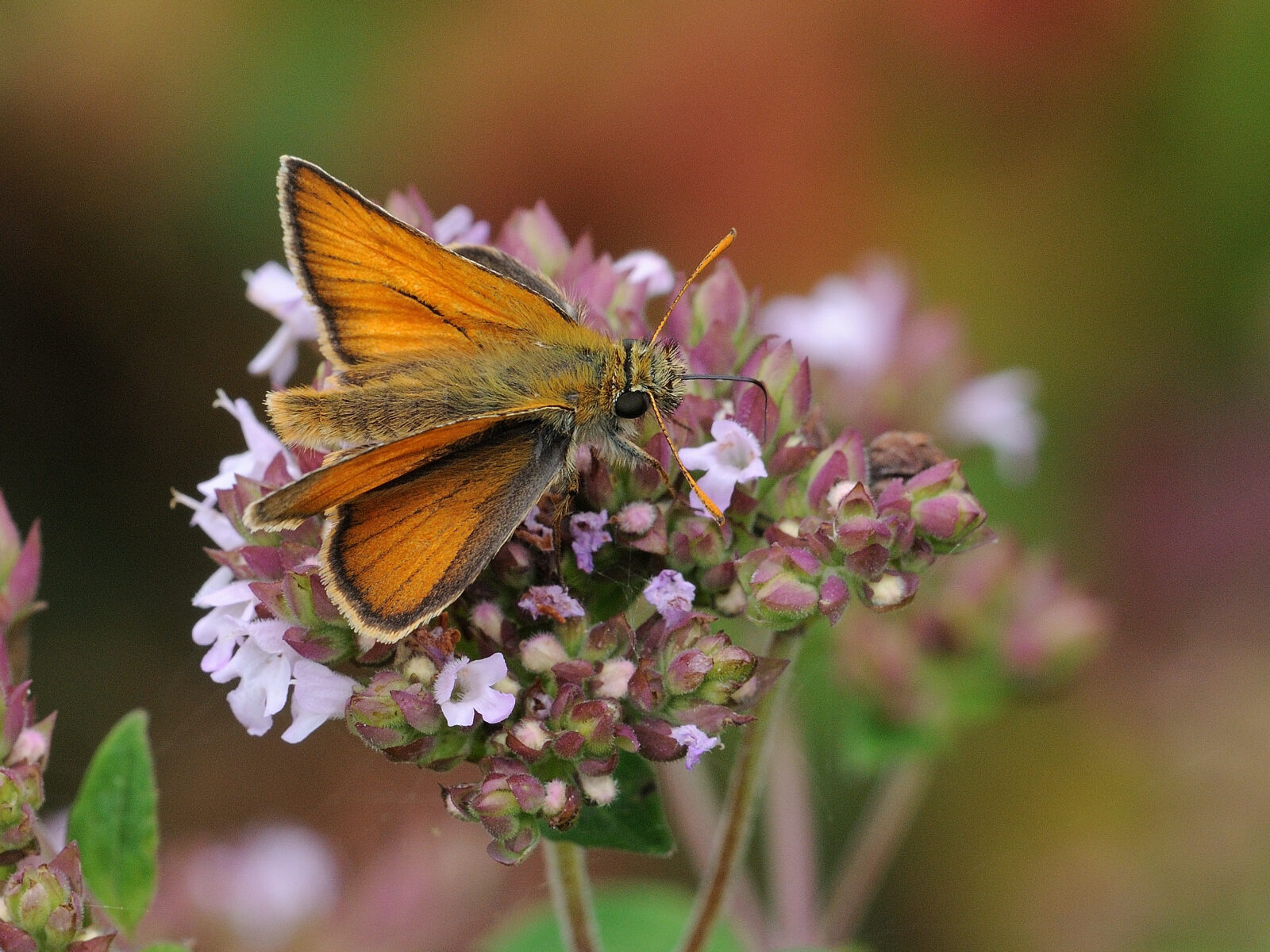
Small Skipper (Thymelicus sylvestris): Recently re-categorized as Endangered at the European level due to a dramatic drop-off in tall, unmanaged dry grasslands. Photo by Tim Worfolk (CC BY NC ND 2.0).
Current conservation policies are predicted not to be sufficient to reverse the decline in common bird and butterfly species
September 7, 2026
A study published in Nature Ecology and Evolution, using data from the Pan-European Common Bird Monitoring Scheme (PECBMS) and the European Butterfly Monitoring Scheme (eBMS) from 2000 to 2021, shows that even the more favourable future scenarios for Europe's land use and climate are unlikely to reverse the negative trends of several declining common species, particularly those associated with farmland.
Small Skipper (Thymelicus sylvestris): Recently re-categorized as Endangered at the European level due to a dramatic drop-off in tall, unmanaged dry grasslands. Photo by Tim Worfolk (CC BY NC ND 2.0).
Human activities and climate change are exerting strong pressures on biodiversity, and many once-common species have declined dramatically, raising serious concerns for biodiversity conservation and the associated ecosystem services. Within this alarming context, it is important to evaluate the likely outcomes of alternative trajectories over the coming decades. The study therefore
- analysed the effects of a range of drivers related to climate, land use and land-use intensity on common bird (265) and butterfly (144) species across 27 European countries between 2000 and 2021;
- considered future climate, land-use and land-use-intensity scenarios, including protected-area coverage, made available by the Intergovernmental Science-Policy Platform on Biodiversity and Ecosystem Services (IPBES) under the Nature Future Framework (NFF) and by other sources;
- by leveraging the relationships between birds and butterflies, on the one hand, and land use and climate on the other, the possible abundance variations for common birds and butterflies, as well as for some multi-species indicators regularly used for monitoring biodiversity across Europe, were estimated up to 2050 under different NFF scenarios.
Projected trends show improvement over the recent past, but once-common bird species that were already declining will continue to decline. This was especially true for farmland birds, even under scenarios that meet conservation objectives. No single scenario could stop or reverse the average decline in either birds or butterflies.
Those results have important implications. Without a real change that moves us away from futures associated with a growing need for natural resources – and especially without stronger action on agricultural intensity and landscape diversity – it will be difficult to halt and reverse the negative trends in the decline of common species that policy indicators currently track. This carries consequences not only for conservation but potentially also for society, given the contribution that abundant species make to ecosystem functioning and services.
The study, led by Stanislas Rigal, involved a large collaboration of national coordinators of common bird and butterfly monitoring schemes and once again demonstrated the importance of large-scale, coordinated efforts (such as PECBMS) for monitoring biodiversity. The study was published in Nature Ecology and Evolution 10, 1694-1708 and is available (under subscription access) here. You can read it here: read-only link.