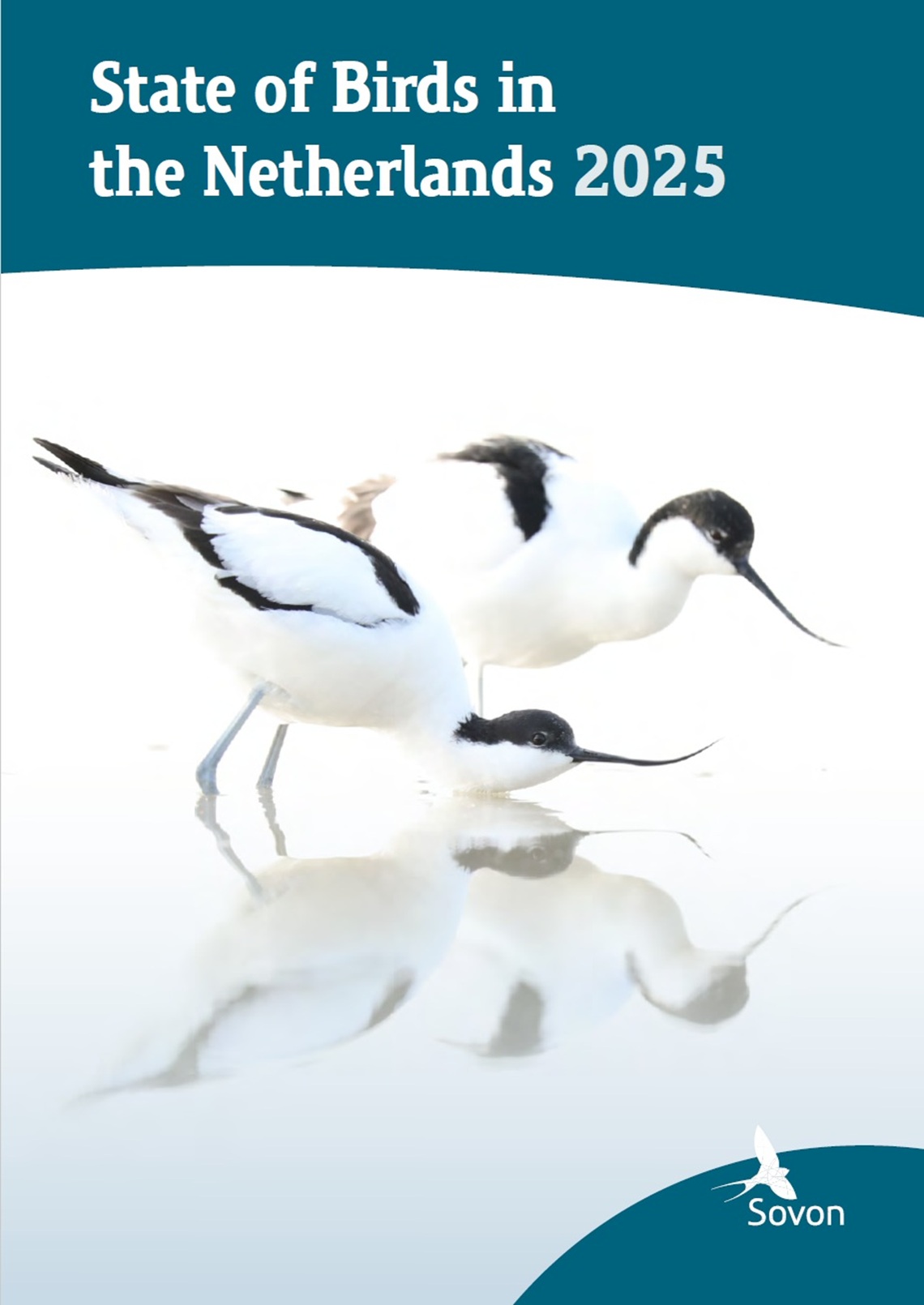
State of Birds in the Netherlands 2025 – Current developments in the Netherlands
April 1, 2026
Sovon Dutch Centre for Field Ornithology recently published its annual State of Birds. In this report, the most important current developments are listed in concise items, compiling knowledge and trends of 200 breeding and 204 migratory and wintering bird species. This information is based on data collected by volunteers throughout the country.
In the 2025 edition, a regular overview of species trends is provided, and the most notable developments and their possible causes are discussed. Representing the sustainability of a species, the Conservation Status (CS) is an important concept in nature policy and for bird conservation. In the State of Birds, a reconstruction is provided for breeding and non-breeding bird species. Trends differ strongly between habitats: species associated with farmland and open landscapes continue to decline, largely due to agricultural intensification and habitat loss, whereas many forest and marshland species have remained stable or increased in recent decades.
Population developments in the Netherlands also show interesting contrasts with trends elsewhere in Europe. In several cases, changes in Dutch populations differ from those observed at the European level. Long-term monitoring series from different regions of the country illustrate how bird populations have changed over time and how factors such as land use, habitat restoration and climate conditions may influence these trends.
Migratory species highlight the importance of international connections. Many waterbirds depend on the East Atlantic Flyway, a migration route that links breeding areas in the Arctic with wintering areas in Europe and Africa. This flyway is monitored every three years through large international counts involving tens of thousands of volunteers across dozens of countries. Research on species using this route, such as the Barnacle Goose, provides new insights into migration behaviour, population dynamics and the role of the Netherlands within broader flyway populations. Together, these findings underline that birds remain important indicators of biodiversity and of the relationship between human activities and the natural environment.
Read more: https://stats.sovon.nl/pub/publicatie/22679